
Teaching Objectives and Course Structure
Teaching Objectives and Course Structure | File Downloads
Teaching Objectives
To ensure that the Institute’s educational philosophy is effectively implemented in curriculum design and faculty teaching, teaching objectives and curriculum areas have been established for different academic programs based on the Institute’s curriculum framework. The teaching objectives and curriculum areas for each program are presented in the table below.
Program |
Teaching Objectives |
Key Curriculum Areas |
|---|---|---|
Master’s Program |
To cultivate students’ ability to apply process planning, information technology, and business management knowledge on the basis of research and analytical methods, enabling them to integrate relevant expertise and assist enterprises in addressing issues ranging from operational management problems to broader challenges within supply chain and manufacturing systems. |
Research Methods, Supply Chain Management, Quality Management, Business Management, Planning and Control |
Executive Master’s Program |
To guide students in applying theoretical methods and frameworks to their practical professional contexts, with an emphasis on applied business management and industrial e-business development. |
Research Methods, Supply Chain Management, Quality Management, Enterprise Resource Planning, Business Management |
Doctoral Program |
To cultivate faculty members and professionals in fields related to industrial management, equipping them with teaching and research capabilities, and enabling them to identify significant supply chain management issues in domestic and international business practices and investigate their underlying causes. |
Quantitative Methods, Production Management, Logistics Management, Enterprise Modeling |
Related academic activities include enabling graduate students to enter their professional fields, conduct research, publish research outcomes, and contribute to society. The Institute recognizes that cultivating talented individuals is central to the mission of education and to the academic responsibilities of faculty members. Therefore, in both curriculum design and faculty teaching, the Institute follows a principle that places people at the center and uses science as a supporting foundation, thereby closely integrating research and scholarship with teaching. The following tables present the Institute’s curriculum plans.
Master’s and Doctoral Programs
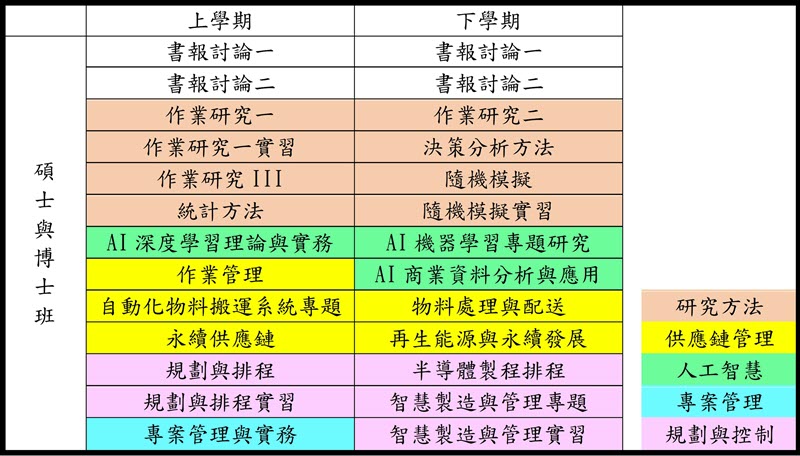
Image description:First- and second-semester curriculum plan for the master’s and doctoral programs
The first-semester plan lists Seminar I, Seminar II, Operations Research I and its practicum, Operations Research III, Statistical Methods, AI Deep Learning Theory and Practice, Operations Management, an Automated Material Handling Systems project, Sustainable Supply Chains, Planning and Scheduling and its practicum, and Project Management and Practice. The second-semester plan lists Seminar I, Seminar II, Operations Research II, Decision Analysis Methods, Stochastic Simulation and its practicum, AI Machine Learning Special Topics, AI Business Data Analytics and Applications, Material Handling and Distribution, Renewable Energy and Sustainable Development, Semiconductor Process Scheduling, and Smart Manufacturing and Management special topics and practicum. Colors identify research methods, supply chain management, artificial intelligence, project management, and planning and control.
Back to First- and second-semester curriculum plan for the master’s and doctoral programs
Executive Master’s Program
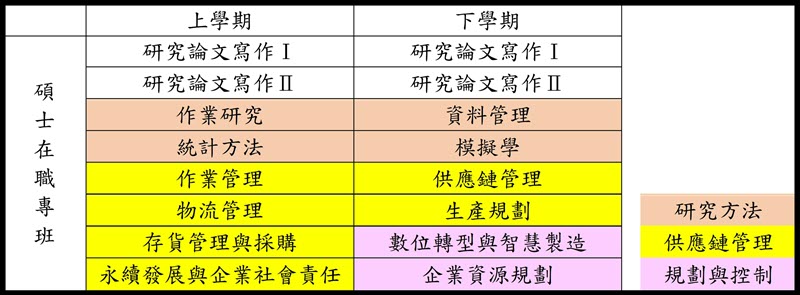
Image description:First- and second-semester curriculum plan for the executive master’s program
The first-semester plan lists Thesis Writing I, Thesis Writing II, Operations Research, Statistical Methods, Operations Management, Logistics Management, Inventory Management and Purchasing, and Sustainable Development and Corporate Social Responsibility. The second-semester plan lists Thesis Writing I, Thesis Writing II, Data Management, Simulation, Supply Chain Management, Production Planning, Digital Transformation and Smart Manufacturing, and Enterprise Resource Planning. Colors identify research methods, supply chain management, and planning and control.
Back to First- and second-semester curriculum plan for the executive master’s program
Course Structure
The Institute currently offers doctoral, master’s, and executive master’s programs. The curriculum framework is built upon foundational methodology courses and complemented by ERP system courses. Based on this structure, four major areas have been developed: Quality Management, Supply Chain Management, Business Management, and Planning and Control, as shown in Figure 1. In alignment with the Institute’s professional fields and research priorities, these four specialized areas play important roles at different stages of educational development. Through this framework, the Institute aims to cultivate outstanding talent in industrial management, pursue academic and professional excellence, and ultimately become a world-class teaching and research institution in industrial management.
As a result of industrial integration and inter-firm collaboration, enterprises no longer operate in isolation. Accordingly, the Institute’s curriculum philosophy emphasizes cultivating students’ ability to integrate relevant management theories, information technology, analytical methods, and business management knowledge for practical application in future supply chain systems. This enables students to assist enterprises in identifying business environments and opportunities, effectively solving management problems, and creating competitive advantages, as illustrated in Figure 2.
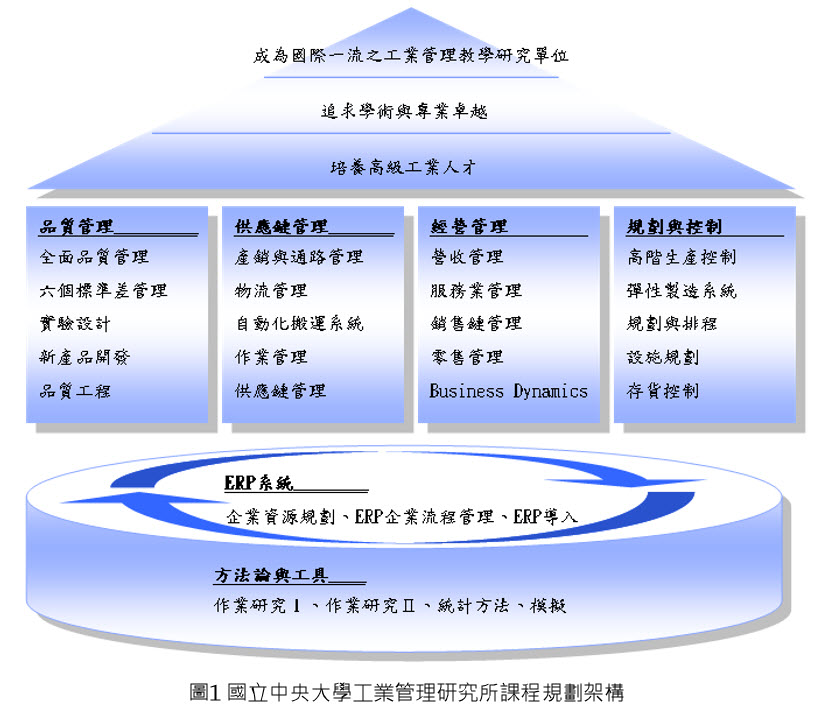
View detailed description of Four-domain curriculum structure built on methodology and ERP
Image description:Four-domain curriculum structure built on methodology and ERP
The diagram is read from bottom to top. The foundation is methodology and tools: Operations Research I, Operations Research II, Statistical Methods, and Simulation. Above it is an ERP layer covering Enterprise Resource Planning, ERP Business Process Management, and ERP implementation. Four curriculum domains build on this foundation. Quality management contains Total Quality Management, Six Sigma Management, Design of Experiments, New Product Development, and Quality Engineering. Supply chain management contains Marketing and Channel Management, Logistics Management, Automated Material Handling Systems, Operations Management, and Supply Chain Management. Business management contains Revenue Management, Service Management, Sales Chain Management, Retail Management, and Business Dynamics. Planning and control contains Advanced Production Control, Flexible Manufacturing Systems, Planning and Scheduling, Facilities Planning, and Inventory Control. The four domains support the goals of cultivating advanced industrial talent, pursuing academic and professional excellence, and ultimately becoming an internationally leading industrial-management teaching and research institute.
Back to Four-domain curriculum structure built on methodology and ERP
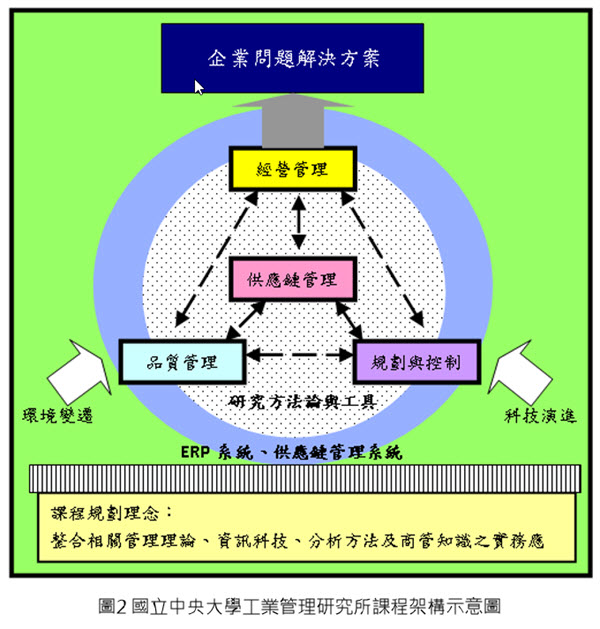
Image description:Relationship between the industrial-management curriculum and enterprise problem solutions
Supply chain management appears at the center of the diagram and has two-way relationships with business management above, quality management at lower left, and planning and control at lower right. Business management is also linked to quality management and planning and control, while quality management and planning and control are linked to each other. The four domains are supported by research methods and tools and by ERP and supply-chain management systems, and together lead upward to enterprise problem solutions. Environmental change and technological evolution appear as external influences on the left and right. The caption at the bottom states that the curriculum integrates management theory, information technology, analytical methods, and practical business knowledge.
Back to Relationship between the industrial-management curriculum and enterprise problem solutions
File Downloads
- First-Semester Course Schedule for the Master’s and Doctoral Programs, Institute of Industrial Management.pdf
- Second-Semester Course Schedule for the Executive Master’s Program, Institute of Industrial Management.pdf
- First-Semester Course Schedule for the Executive Master’s Program, Institute of Industrial Management.pdf
- Second-Semester Course Schedule for the Master’s and Doctoral Programs, Institute of Industrial Management.pdf